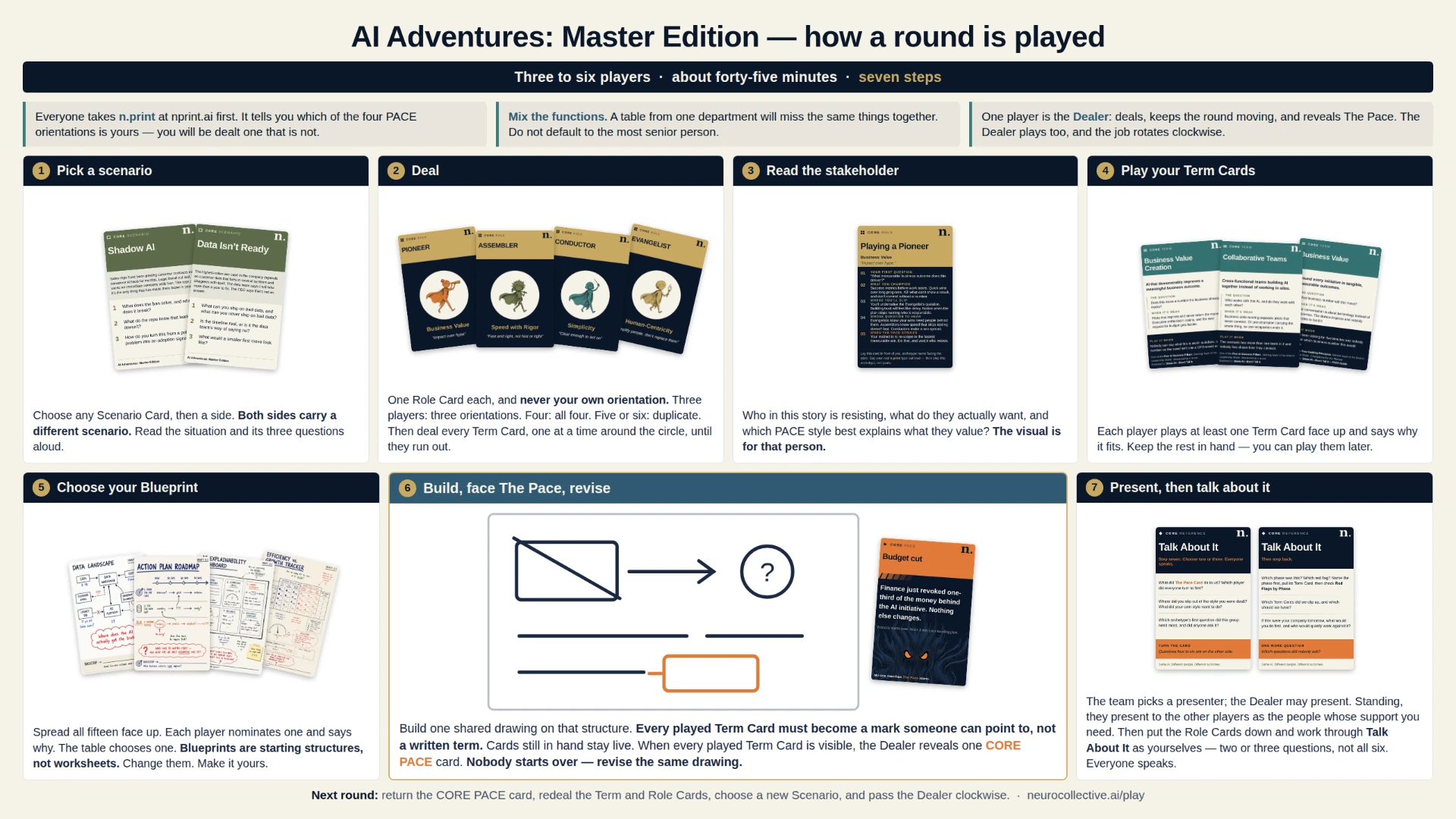
Start to finish
A round
Before you play
Three to six players, mixed functions. Everyone takes n.print at nprint.ai before they sit down. You will be dealt a style that is not your own, and knowing yours tells you which one to avoid. Do not default to the most senior person to lead the discussion or make the decision. The board belongs to the table: anyone can pick up a marker without asking. You need the seventy-two cards in the box. A card stand for each player and a whiteboard with markers are ideal.
One player is the Dealer. They deal, keep the round moving, and reveal The Pace. The Dealer plays too, and the role rotates clockwise each round. There is no facilitator at the table and no timer. Running several tables at once is a different job — see . Plan on about 45 minutes.
Pick a scenario
Choose any Scenario Card, then a side. Read the situation and its three questions aloud.
Deal
One Role Card each, and never your own style.
Three players: three different styles. Four: all four. Five or six: duplicate as needed. Then deal every Term Card, one at a time around the circle, until they run out. Hands will be uneven. That is correct.
Read the stakeholder
Who in this story is resisting, what do they actually want, and which PACE style best explains what they value?
The visual is for that person.
Play your Term Cards
Each player plays at least one face up and says why it fits.
Keep the rest in hand. You can play them later.
Choose your Blueprint
Spread all fifteen face up. Each player nominates one and says why.
The table chooses one; the rest stay face up as a toolkit. Blueprints are starting structures, not worksheets. Change them. Make it yours.
Build, face The Pace, revise
Build one shared drawing on that structure.
Every played Term Card must become a mark someone can point to, not a written term. Cards still in hand stay live. When every played Term Card is visible, the Dealer reveals one CORE PACE card. Nobody starts over. Revise the same drawing.
Present, then talk about it
The team picks a presenter; the Dealer may present.
Standing, they present to the other players as the people whose support you need. Then put the Role Cards down and work through Talk About It as yourselves. Choose two or three questions, not all six.
Next round. Return the CORE PACE card, redeal the Term and Role Cards, choose a new Scenario, pass the Dealer clockwise.
At the table
Stuck right now?
How do we know when The Pace comes out?
What counts as visible?
We're arguing about the drawing.
Someone got their own style.
We only have three players.
Which pile is which?
Can we use two Blueprints?
We're out of time.
Nobody is talking.
For facilitators
Running a room
The room clock — six tables, one round, about 75 minutes
| Minutes | What happens |
|---|---|
| 0–5 | Dealers named. Each table reads its scenario aloud. |
| 5–12 | Roles and Term Cards dealt; the stakeholder read. |
| 12–20 | Term Cards played; Blueprints chosen. |
| 20–45 | Build. Each Dealer reveals The Pace when every played Term Card at that table is visible — on their clock, not yours — and the table revises the same drawing. Ask the milestone question around minute 32. |
| 45–50 | Present. Every table at once, one presenter standing at each board. |
| 50–60 | Talk About It at each table. Do not intervene. |
| 60–70 | Gallery walk. Boards stay up; the room moves. |
| 70–75 | Close on one pattern you saw across the room. |
A single table plays a round in about forty-five minutes. Six tables take about sixty to reach the end of Talk About It, because a room syncs to its slowest table at every gate. Plan for that rather than discovering it.
The milestone question · about minute 32
What perspective are we not hearing right now?
Assigning scenarios. Assign by phase, not preference. Two tables on Foundation, two on Execution, one on Scale, one on Innovation gives the room a full AI Performance Flywheel in one sitting. Running twice? Foundation and Execution first, Scale and Innovation second, and the second debrief asks what changed.
Presenting. Every table presents at the same time, to itself. The presenter stands and pitches to the other players at that table as the people whose support they need. There is no room-wide running order, because nothing is sequential. Rotate the presenter each round so everyone stands at least once.
The gallery walk. Boards stay up. After Talk About It, walk the room in AI Performance Flywheel order: Foundation, Execution, Scale, and Innovation, so the arc assembles as people move rather than as they sit. It comes after Talk About It on purpose: a table that has already named what it built looks at another board to compare, not to copy. This is also what makes the closing questions answerable, since no table watched another present.
Keep the reference stack off the tables. The Core Scenario Key maps each scenario to its red flag, which is the answer to a Talk About It question. The card says do not open until Talk About It. Hold the reference cards yourself and hand them out at the debrief. This is the part the printed card cannot enforce.
Closing questions for the room — choose two or three
- Which table's visual would survive a real board, and what makes the difference?
- Where did a role get played instead of inhabited?
- What perspective did this room not hear today?
- Which red flag showed up at more than one table?
Advanced variants
These are earned, not optional extras. Use them with tables that have played before.
Blueprint stacking. A table may combine two Blueprints when it can say what the first one cannot show. It is withheld from the core rules on purpose: the playtest has to answer whether the single-Blueprint mechanic works before stacking can confound it.
The two-archetype deal. Deal from only two styles, so two are missing entirely. Two or fewer types present is the PACE Guide's definition of a lopsided team. This is not a handicap, it is the most common shape in the field. Add one question to the debrief: which questions did nobody at this table ask?
Trainer depth
Reading the table
The build is the exercise. The diagnosis happens while you watch it.
Stall patterns by dominant type
A table leans the way its players lean. Each lean has a predictable failure point, and each failure point has a tell you can see inside the build.
| Dominant type | Stalls at | What you will see |
|---|---|---|
| Pioneer-heavy | Adoption | A confident plan with no named owner outside the room. The visual answers “is this worth doing?” and never answers who has to change their Monday. |
| Assembler-heavy | Launch | Structure keeps growing. The table refines the framework past the point where new information should have reshaped it, and the presentation has no decision in it. |
| Conductor-heavy | Depth | A clean, legible visual that a risk officer would take apart in one question. Clarity arrived by removing the nuance. |
| Evangelist-heavy | Speed | Every stakeholder gets named and nothing gets decided. Co-creation runs long. |
The four voices, in one line each
Use these to name what a table is missing without naming a person.
Pioneer
Business Value
Asks “What measurable business outcome does this deliver?” Protects business value.
Assembler
Speed with Rigor
Asks “How quickly can we validate that this works correctly?” Protects delivery and risk.
Conductor
Simplicity
Asks “How easily can my team understand and use this?” Protects simplicity and usability.
Evangelist
Human-Centricity
Asks “How will this enhance my team's capabilities?” Protects people and adoption.
The six pairs
Two of the six are tension pairs — the diagonals on the PACE radar. The other four are adjacent pairs, neighbors who move fast together and produce a predictable friction. Adjacent friction is not a tension pair; that term is reserved for the diagonals.
Every table carries both tensions. The question is whether they are productive or unresolved. Pioneer and Evangelist resolve the organization's optimization target, balancing Business Value with Human-Centricity. Assembler and Conductor resolve how the organization delivers, balancing Speed with Rigor against Simplicity.
Tension pairs · diagonal · Chapter 7
Pioneer + Evangelist
The Optimization Tension
- Does well
- The most generative combination on the radar. Pioneer brings the case for change; Evangelist brings the conditions for change to stick.
- Gets stuck
- Pioneer reads Evangelist as a brake on momentum. Evangelist reads Pioneer as indifferent to people. Each starts working around the other.
- Blind spot
- 39% of Pioneers name the Evangelist as their primary blind spot; 32% of Evangelists name the Pioneer.
- Bridge move
- Make adoption a Pioneer KPI, not a separate Evangelist deliverable. Make impact metrics a shared scorecard, not a Pioneer-only artifact. They should never present separately to leadership.
Assembler + Conductor
The Delivery Tension
- Does well
- Assembler builds robust process; Conductor makes the process learnable. Together they create the rare thing in AI rollouts: governance that people actually use.
- Gets stuck
- Assembler adds rigor; Conductor strips it for clarity; the artifact contradicts itself. Assembler may over-engineer a workflow until it is unusable; Conductor may strip out critical technical nuance for the sake of clarity.
- Blind spot
- 39% of Assemblers name the Conductor as their primary blind spot; 29% of Conductors name the Assembler.
- Bridge move
- Build the framework and the explainer in the same sprint, not in sequence. Conductor sits in design reviews; Assembler sits in rollout sessions. Each can flag where the other is breaking the other's work.
Adjacent pairs · neighbors · Chapter 8
Pioneer + Assembler
Ships, and ships measurably
- Does well
- Both action-oriented. Pioneer presses for outcomes; Assembler builds the rails that make the outcome real.
- Gets stuck
- Pioneer pushes for ship dates Assembler doesn't trust. Assembler asks for one more review; Pioneer hears “we'll never launch.” Friction shows up as “cowboy vs. bureaucrat” when Pioneer wants to ship before Assembler's testing framework is complete.
- Bridge move
- Agree on the smallest evidence package that earns Assembler's signature. Time-box rigor explicitly. Pioneer commits to not bypassing process; Assembler commits to a non-negotiable launch window.
Pioneer + Conductor
Strong in Foundation and Scale
- Does well
- Pioneer locks the outcome; Conductor makes it understandable to everyone who has to act on it.
- Gets stuck
- Pioneer may dismiss communication plans as “soft.” Conductor over-translates and softens the outcome metric until it stops driving behavior.
- Bridge move
- Pair them on a single named metric. Pioneer owns the number; Conductor owns whether the org understands the number. They review weekly together.
Assembler + Evangelist
Reliable and trusted
- Does well
- Both quality-conscious. Assembler protects the system; Evangelist protects the people inside it.
- Gets stuck
- Assembler optimizes throughput; Evangelist optimizes felt experience. They can talk past each other entirely.
- Bridge move
- Co-author the rollout plan. Assembler owns the technical readiness gate; Evangelist owns the human readiness gate. Both gates have to clear before launch.
Conductor + Evangelist
The change-management dream pair
- Does well
- Both people-aware. Conductor gives people the words; Evangelist gives people the safety to use them.
- Gets stuck
- Conductor simplifies in ways that feel reductive to Evangelist. Evangelist's listening loops generate complexity that Conductor flattens back out.
- Bridge move
- Use Evangelist's listening data as the input to Conductor's communications. Stop publishing top-down explainers; start publishing answers to the questions Evangelist heard this week.
How to use these at the table. When a build goes quiet or circular, name the pair, read the gets stuck line aloud, and hand the table the bridge move as a constraint for the remaining time.
Show AI—Don't Tell It, Chapter 12
Scenarios with resistance
Two Core scenarios are written as cause and effect: The Efficiency Story and Working Against It. Two more sit alongside them as governance: Who Owns the Agent and One Slide. When a table draws one of these, the material below is what the round is really testing.
Seven groups, seven different fears
Sarah Chen has board approval for an AI-powered claims processing initiative and still hits a wall. Seven groups, each with a valid concern shaped by their own responsibilities:
| Group | What they were protecting |
|---|---|
| Board members | Whether AI aligned with the company's long-term strategy |
| The CFO | The financial return |
| Risk and compliance | Regulatory exposure |
| IT leaders | An integration nightmare |
| Business unit managers | Trust, eroded by AI-driven decisions |
| Frontline employees | Their jobs |
| Claims processing teams | A system that already worked just fine |
Ask in the debrief
Which of these seven has the table not spoken to, and what would that group need to see?
That lesson is the game's foundation. Buy-in does not equal execution.
The resistance spectrum
Resistance rarely arrives as an argument. It arrives as behavior, and it escalates. Give the table the five points and one move for each.
| What you see | What it usually is | The move |
|---|---|---|
| Quiet avoidance | The tool is optional and nothing makes it worth the switch | Co-creation. Put the people who avoid it on the design of the next iteration. |
| Faked use | Logging in satisfies the metric, so the metric is what gets satisfied | Honest measurement. Change what gets counted before changing what gets said. |
| Shadow tools | The sanctioned tool is worse than the unsanctioned one | A sanctioned path. Treat shadow use as an adoption signal and give it somewhere legitimate to go. |
| Metric tampering | Someone is protecting a number that protects them | Start with what the person is protecting. Have that conversation before any conversation about the number. |
| Deliberate poor output | Someone is protecting their standing, or their job | Same move. What the person is protecting comes first; everything else is downstream. |
The cause, in almost every case, is fear of replacement — and it is fed by leaders who say, out loud or by implication, that non-adopters will be cut. A table that diagnoses tooling when the answer is fear has found the round's real lesson.
The board-facing prompts
Three prompts to carry into the presentation and the debrief. Use them as tests of what the table built, not as extra questions during the build.
Read aloud before the presentation
“Where's the proof?”
“Show me.”
Show AI—Don't Tell It · Chapters 5 and 11
If the visual answers the first and cannot survive the second, the table built a report, not a Visual Dartboarding artifact.
Hold until the debrief
How do you know your usage numbers are real?
Ask it of any table whose plan rests on a dashboard.
Whole-room debrief · and the test for One Slide
“Show me the PACE shape of our AI leadership team. Where are the gaps, and what is the plan to cover them?”
The PACE Guide · Chapter 13
Print and hand out
Downloads
Rebuilt for v1.1. Nothing here sits behind a form. All three sheets are ready now.
Player reference (PDF, 2 pages)
The round on one sheet and the debrief on the other. Print one per table.
Download the player referenceThe printable table layout
The diagram from the Know Your Cards card, letter size, one per table. Letter, landscape.
Download the table layoutSources
- Red flags by phase — Table E.1, Appendix E, Show AI—Don't Tell It (Wiley, 2026)
- Seven stakeholder groups, and the resistance material — Chapter 12, From Resistance to Results
- The board's two questions — Chapters 5 and 11
- The two tension pairs and the blind-spot data — the PACE Guide, Chapter 7, Tension Pairs: Why Opposites Need Each Other
- All six pairs, including the four adjacent pairs and their bridge moves — the PACE Guide, Chapter 8, The Six Pairs: How Every Combination Works
- Stall patterns and the board question — the PACE Guide, Chapter 13, Leading with PACE
- The Bold AI Leadership Model, the Five AI Success Pillars, the Four Guiding Principles, and the AI Performance Flywheel — AIE curriculum canon
Book excerpts are drawn from Show AI—Don't Tell It by Dr. Lisa Palmer, published by Wiley. PACE is AIE-developed and is not sourced from the book.
Same AI. Different people.
Different outcomes.